

Can a Straighten Brush be used on chemically treated hair?
Nov 07, 2025
Hey there, fellow hair enthusiasts! As a supplier of straighten brushes, I get tons of questions from customers. One question that pops up a lot is, "Can a straighten brush be used on chemically treated hair?" Well, let's dig into this topic and find out.
First off, let's talk about what chemically treated hair is. Chemically treated hair includes hair that's been permed, relaxed, colored, or bleached. These treatments change the structure of your hair on a chemical level. For example, a perm uses chemicals to break and reform the disulfide bonds in your hair, giving it a curly or wavy shape. A relaxer does the opposite, breaking those bonds to make your hair straight. Coloring and bleaching involve using chemicals to either add or remove color from your hair.
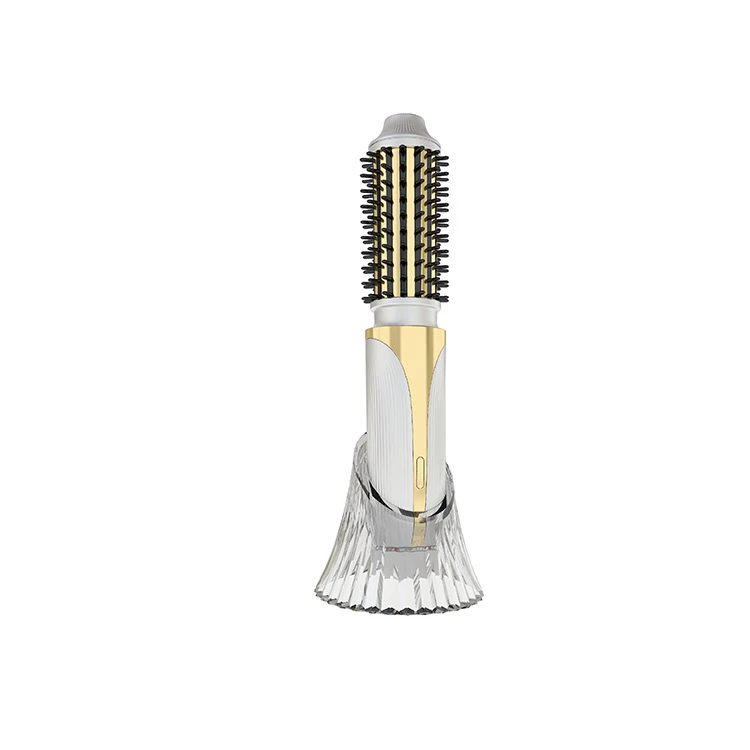
Now, let's look at straighten brushes. A straighten brush is a handy tool that combines the functions of a hairbrush and a straightener. It heats up and can quickly straighten your hair as you brush through it. We offer some really cool models, like the Portable Rechargeable Hair Straightening Comb With 24K Gold, Compact in Size, Fits Easily Into Your Handbag. This one is super convenient for those on - the - go days. And then there's the Infrared Cold Air Hair Straightening Brush With 200 Million Negative Ions For Long - Lasting Styling, which uses infrared technology and negative ions to give your hair a long - lasting style while being relatively gentle.
So, can you use a straighten brush on chemically treated hair? The answer is yes, but with some precautions. Chemically treated hair is more fragile than natural hair. The chemical processes weaken the hair shaft, making it more prone to damage from heat. When you use a straighten brush on chemically treated hair, you need to be extra careful about the heat settings.
Most straighten brushes come with adjustable heat settings. For chemically treated hair, it's best to start with a lower heat setting. High heat can cause the hair to become dry, brittle, and even break off. You don't want that! For example, if your straighten brush has settings from 150°C to 230°C, start at around 150°C or 160°C and see how your hair reacts. If it's not getting straight enough, you can gradually increase the heat, but don't go too high.
Another important thing is to use a heat protectant spray. A heat protectant forms a barrier between your hair and the heat of the straighten brush. It helps to reduce the damage caused by the high temperatures. You can spray it on your hair before using the straighten brush. Just make sure to evenly distribute it through your hair for maximum protection.
Let's also talk about the frequency of use. Don't use the straighten brush on your chemically treated hair every day. Give your hair some time to recover between uses. Using it too often can lead to cumulative damage over time. Maybe limit it to 2 - 3 times a week.

Now, let's take a closer look at the different types of chemically treated hair and how to use a straighten brush on them.
Permed Hair
Permed hair has a lot of curls or waves that are set by chemicals. If you want to straighten it with a straighten brush, be gentle. Start with a low heat setting and slowly work through your hair. You might need to go over each section a few times, but don't be too aggressive. Remember, the curls in permed hair are more delicate, and you don't want to break them or cause the hair to lose its shape completely.
Relaxed Hair
Relaxed hair has already been chemically straightened. However, it can still benefit from a straighten brush to give it a sleeker look. But again, use a lower heat setting. Relaxed hair can be very dry and prone to breakage, so you need to be extra careful not to over - heat it. Also, make sure to moisturize your hair regularly to keep it healthy.
Colored or Bleached Hair
Colored and bleached hair is often dry and porous. The chemicals used in these processes open up the hair cuticles, making the hair more vulnerable to heat damage. When using a straighten brush on colored or bleached hair, use a heat protectant religiously. And like with other chemically treated hair, start with a low heat setting. You might also notice that the color can fade faster with heat exposure, so try to keep the heat as low as possible while still achieving the desired straightening effect.
Our Professional Rechargeable Cordless Straightening Brush is a great option for chemically treated hair. It's cordless, which gives you more freedom of movement while styling. And it has good heat control features, allowing you to set the heat at a level that's safe for your chemically treated hair.
In addition to the heat settings and using a heat protectant, you should also take good care of your chemically treated hair in general. Use a good quality shampoo and conditioner that are specifically designed for chemically treated hair. These products can help to repair and strengthen the hair. You can also use hair masks once a week to give your hair an extra boost of moisture.
If you're still not sure about using a straighten brush on your chemically treated hair, you can do a small test first. Take a small section of hair at the back of your head and use the straighten brush on it with a low heat setting. See how the hair looks and feels after. If it seems okay, then you can proceed with straightening the rest of your hair.
To sum it up, using a straighten brush on chemically treated hair is possible, but you need to be cautious. Adjust the heat settings, use a heat protectant, and limit the frequency of use. By following these tips, you can enjoy the benefits of a straighten brush without causing too much damage to your precious chemically treated hair.
If you're interested in our straighten brushes and want to learn more about how they can work for your chemically treated hair, or if you're a retailer looking to stock our products, we'd love to have a chat with you. Just reach out for a procurement discussion, and we can work together to find the best solutions for your hair - styling needs.
References
- "The Science of Hair Care" by Philip Kingsley
- "Hair: Its Beauty and Care" by John H. Waite