

How does a battery straightener affect the battery's chemical composition?
Sep 24, 2025
Hey there! As a supplier of Battery Straighteners, I often get asked about how these nifty gadgets affect a battery's chemical composition. So, let's dive right in and break it down in a way that's easy to understand.
First off, what's a battery straightener? Well, it's a type of Battery Straightener that's powered by a battery, giving you the freedom to style your hair without being tied to an outlet. But how does it interact with the battery's innards?
Most modern battery straighteners use lithium-ion batteries. These batteries are popular because they're lightweight, have a high energy density, and can handle a good number of charge-discharge cycles. The basic chemical composition of a lithium-ion battery consists of a cathode, an anode, and an electrolyte.
The cathode is typically made of a lithium metal oxide, like lithium cobalt oxide or lithium iron phosphate. The anode is usually graphite, and the electrolyte is a lithium salt dissolved in an organic solvent. When the battery is charged, lithium ions move from the cathode to the anode through the electrolyte. When the battery is discharged (like when you're using your Professional Rechargeable Cordless Hair Straightener), the lithium ions move back to the cathode.
Now, let's talk about how a battery straightener affects this chemical composition. When you turn on your battery straightener, the battery starts to discharge. The electrical energy from the battery is converted into heat energy to heat up the straightening plates. This discharge process causes the lithium ions to move from the anode back to the cathode.
As the battery discharges, the chemical reactions at the electrodes change. At the anode, the graphite structure releases the lithium ions, and at the cathode, the lithium metal oxide accepts the ions. These reactions are reversible, which is why lithium-ion batteries can be recharged.
However, every time the battery goes through a charge-discharge cycle, there are some side reactions that occur. For example, over time, a solid electrolyte interphase (SEI) layer forms on the anode. This layer is made up of decomposition products of the electrolyte and helps to protect the anode from further reactions with the electrolyte. But if the SEI layer becomes too thick, it can increase the internal resistance of the battery, reducing its performance.
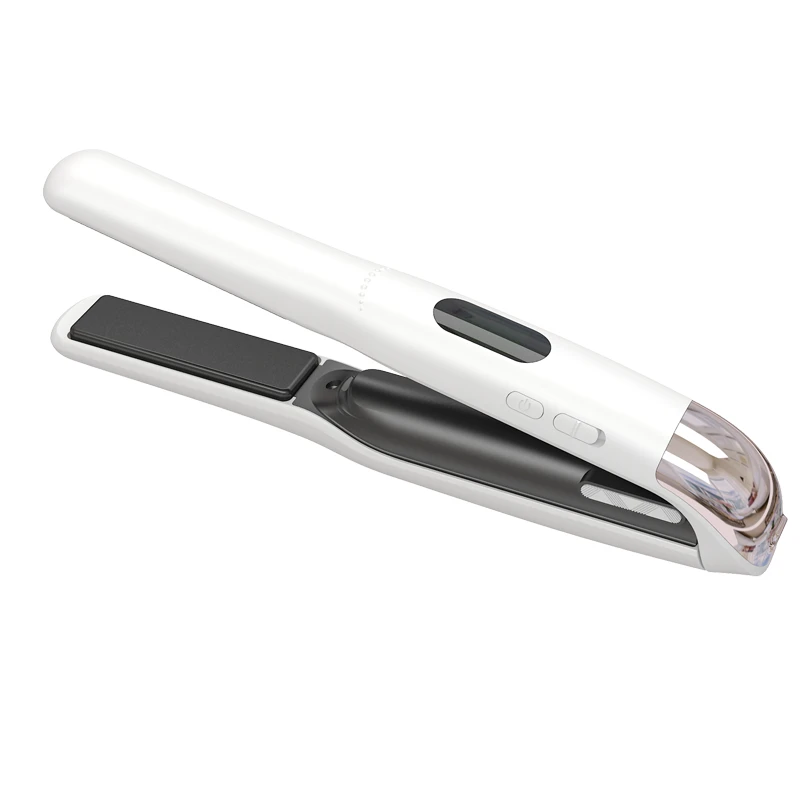

Another factor that affects the battery's chemical composition is the temperature. Battery straighteners generate a lot of heat, and high temperatures can accelerate the side reactions in the battery. For instance, at high temperatures, the electrolyte can decompose more rapidly, leading to the formation of more SEI layer and the loss of active lithium ions. This can cause the battery to lose its capacity over time.
The charging process also plays a crucial role in the battery's chemical composition. When you charge your battery straightener, you need to make sure you're using the right charger. Overcharging can cause the lithium ions to deposit on the anode in a non-uniform way, leading to the formation of lithium metal dendrites. These dendrites can grow and penetrate the separator between the anode and the cathode, causing a short circuit and potentially leading to a fire or explosion.
On the other hand, undercharging can also be a problem. If the battery is not fully charged, there will be fewer lithium ions available at the cathode during discharge, reducing the battery's capacity.
So, how can you take care of your battery straightener's battery to minimize the negative effects on its chemical composition? Here are some tips:
- Avoid overheating: Don't use your battery straightener for extended periods without giving it a break. Let it cool down between uses.
- Use the right charger: Always use the charger that came with your battery straightener or a charger that's specifically designed for your battery type.
- Don't overcharge or undercharge: Charge your battery straightener to the recommended level and avoid leaving it on the charger for too long.
- Store it properly: If you're not going to use your battery straightener for a while, store it in a cool, dry place with a partial charge.
As a supplier of Battery Straighteners, I understand the importance of providing high-quality products that not only style your hair but also take care of the battery. Our battery straighteners are designed with advanced charging circuits to prevent overcharging and overheating. We also use high-quality lithium-ion batteries that are more resistant to the side reactions that can degrade the battery's performance.
If you're in the market for a new battery straightener, whether it's for personal use or for your salon, we've got you covered. Our products are reliable, efficient, and will give you great results every time. And if you have any questions about our battery straighteners or how to take care of the batteries, don't hesitate to reach out to us. We're here to help you make the most of your hair styling experience.
In addition to our battery straighteners, we also offer Beard Flat Iron for those who want to keep their beards looking sharp. These flat irons are also powered by high-quality batteries and are designed to be gentle on your facial hair.
If you're interested in purchasing our products in bulk or have any questions about our pricing and terms, we'd love to have a chat with you. Just get in touch, and we'll work with you to find the best solution for your needs.
References
- Linden, D., & Reddy, T. B. (2002). Handbook of Batteries. McGraw-Hill.
- Tarascon, J. M., & Armand, M. (2001). Issues and challenges facing rechargeable lithium batteries. Nature, 414(6861), 359-367.